
Unified Time and Frequency Solutions for the Intelligent Transportation Industry

Intelligent Transportation Unified Time and Frequency Solution

Covering urban traffic control, intelligent high-speed, rail transportation, vehicle and road coordination of the whole area of the precise time system.

There exists a clear hierarchical need for time synchronization accuracy within the ITS, which can be classified by business characteristics:

  • Sub-microsecond and nanosecond:It is suitable for Vehicle-to-Guideway Collaboration (V2X), part of the rail signaling system, precise event correlation and high-precision positioning fusion.
  • Sub-millisecond and microsecond:Suitable for urban signal control (green wave coordination, bus priority), electronic police/cardinal multi-device forensics, gantry billing, roadway-level event detection, etc.
  • Milliseconds:Suitable for video surveillance, information distribution, management platforms, office systems, etc.

The above three types of demands coexist in the same city and the same road network, and it is not possible to cover all the scenarios with a single precision and a single protocol, so it is necessary to match them through a unified time base and a hierarchical access strategy.

Typical problems of the current network

The following problems are prevalent in the current network in city traffic control, smart highway and rail transit projects nationwide:

Large intergenerational span of equipment

  • The core routers and some aggregation switches already support PTP;
  • Bulk stock access switches support only basic Layer 3 forwarding and do not support PTP hardware timestamping or BC/TC functionality;
  • The protocols supported by the front-end devices are not standardized, some support PTP, some only support NTP or serial port timing.

Mixed use of timing devices, non-harmonized protocol stacks

  • Coexistence of multiple timing schemes within the same network
  • Time sources are not managed in a uniform manner, and there are deviations of seconds and even minutes between systems.

Lack of unified monitoring and operation and maintenance tools

  • Lack of visual monitoring of the quality of the upper time sources (BeiDou, GPS, higher-level PTP);
  • Lack of centralized monitoring of deviation and jitter of downstream PTP/NTP clients;
  • In the event of a green wave failure, forensic dispute, or billing complaint, it is difficult to quickly pinpoint whether time synchronization is the root cause.

Security Domain Segmentation and Time Basis Splitting

  • Physical or logical isolation exists for public security networks, specialized video networks, government networks, and specialized networks for vehicle and road collaboration;
  • Timing devices are often deployed independently within each security domain, resulting in inconsistent time baselines;
  • Lack of engineering means to achieve a uniform time reference in the context of "disconnected network traffic".

Design Principles

The overall design of the program is guided by the following three principles:Harmonization of benchmarks,Tiered access,smooth evolution

overall structure

core layer

  • Consisting of the T830 Clock Server, it provides intelligent selection of multiple reference sources, dual PTP/NTP engines, and multiple interface outputs (PTP, NTP, 1PPS, 10 MHz, IRIG-B, etc.);
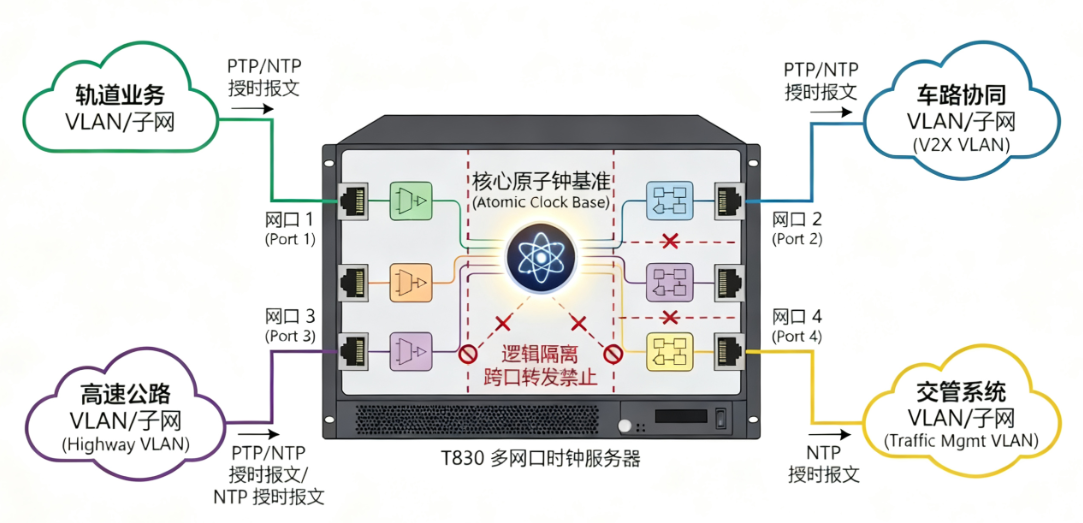
  • Provides multiple Ethernet network ports, all of which share the same operating system and the same security boundary, and can logically divide service network segments within the same security domain, providing a unified time base for different service VLANs/subnets.

transport layer

  • Carrying PTP/NTP grant traffic. available:
  • PTP trunks that support BC/TC;
  • Unicast PTP based on 8275.2;
  • NTP on an existing Layer 3 network.

access layer

  • For specific business endpoints, including:
  • City signals, radar, RSUs, gantry controllers, track signaling equipment;
  • E-police, bayonet, video front-end, PIS, AFC, management platform, etc;
  • Select the PTP or NTP access method by service level.

Industry subsystems

  • City traffic management, intelligent high-speed, rail transportation, vehicle-road coordination, etc., are connected to the core layer through their respective professional networks or dedicated networks to share a unified time reference.

system architecture

The core layer is centered on the T830 high-performance clock server, which provides a unified time reference and multi-protocol output capability, and the main functions include:

1、Multi-reference source and intelligent source selection

Supports a variety of upstream reference sources: BeiDou timing signals; other GNSS such as GPS; upper-level PTP (PTP benchmark provided by the group or elsewhere); wired reference sources such as terrestrial 1PPS/10 MHz.

2、PTP/NTP dual-engine architecture
  • PTP Engine
    • Implement IEEE 1588v2 PTP Grandmaster/BC functionality based on hardware timestamps;
    • Supports multi-Domain, multi-Profile (e.g., G.8275.1, G.8275.2), and can provide independent PTP time domains for different business domains;
    • Supports configurable parameters for message rate, delay mechanism, and priority.
  • NTP Engine
    • Built-in high concurrency NTP server, support large-scale terminal concurrent timing;
    • Supports control of access sources (ACLs) in conjunction with network-side security policies.

Both engines share the same atomic clock as the local clock source, and share the same set of multi-reference source intelligent source selection algorithm to ensure that PTP and NTP outputs are in the same time base.

3、Multi-network port output

The T830 provides multiple Ethernet ports for logical partitioning of business network segments on the same device:

  • Port Independent Configuration
    • Each physical network port can be configured independently: IP address and subnet, access control policy; PTP function switch, Profile type, message rate;
    • The network parameters for different ports are independent of each other.
  • network layer isolation
    • All physical network ports share the same operating system and the same security perimeter;
    • Each network port is used at the network level only as a timing service outlet;
  • Harmonization of time frames
    • The PTP/NTP protocol stack for all ports shares the same atomic clock and multiple reference source algorithm internally;
    • Provides a unified time base for multiple business network segments, subject to logical partitioning.
  • Security Domain Usage Boundary Statement
    • A multi-port design is not the same as physically isolating the device across security domains;

For different security domains that require physical isolation in the security specification (e.g. public security private network and external network), T830 should be deployed or other isolation means should be used in each security domain separately, and timing should not be provided by a single T830 across domains at the same time.
4. Timekeeping capability and output interface

Punctuality:

  • An optional thermostatic crystal or rubidium clock provides hourly to daily timekeeping accuracy in the event of an upstream reference source failure;
  • The output side uses step-limiting and gradual convergence strategies to avoid the impact of time jumps on the business system.

Output Interface:

  • IP protocol output: PTP, NTP;
  • Physical signal output: 1 PPS, 10 MHz, IRIG-B (code type optional);

Meet the needs of multi-disciplinary system access such as signaling, electric power, and weak power.


The transport layer is responsible for carrying timing protocol traffic within the same security domain or route-accessible network and is designed in a patterned manner:

1. Mode A: PTP BC/TC Trunk (Multicast)
    • Condition: PTP BC/TC and SyncE are universally supported on core, aggregation, and access switches;
    • Network topology: core T830 as GM, extend PTP domain downstream through multi-level BC/TC;
    • Applicable Scenarios:
      • New demonstration areas;
      • Orbital signaling network;
      • Specialized networks that require sub-microsecond to nanosecond accuracy, such as the Vehicle-Road Collaboration Specialized Network (VRSN).
2. Mode B: Unicast PTP (G.8275.2)
  • Condition: The intermediate transport network supports only normal Layer 3 forwarding and does not have PTP BC/TC functionality;
  • Network topology: the T830 or PTP border clock establishes a one-to-one PTP session with the terminal or edge miniclock via G.8275.2. the intermediary device does IP forwarding only;
  • Applicable scenarios: urban traffic management inventory network, aggregation/access does not uniformly support PTP; high-speed road sections across the carrier's private line or multi-level three-tier network key links; target accuracy of microseconds to sub-microseconds scenarios.
        •  
Mode C: Pure NTP mode
  • Condition: The network is only capable of providing basic IP connectivity and is not suitable for introducing PTP;
  • Network Topology: The T830 acts as an upstream NTP server, directly timing endpoints or subordinate NTP servers;
  • Applicable scenarios: video surveillance, management platform, office system; edge sites, independent intersections, small toll stations and other areas with restricted network conditions;
  • Requires millisecond to sub-millisecond time accuracy.

The three modes can exist in parallel in the same city or within the same road network, with combinations chosen according to network conditions and service levels.

Access level to all types of business terminals, access mode design by accuracy level and protocol capability:

1. PTP access terminal

Including: signaling machine, RSU, track signaling equipment, some gantry controllers, high-precision radar and so on;

Access method: In Mode A network, as a PTP client to access the access switch that supports PTP; in Mode B network, to establish a session directly with T830 or border clock via Unicast PTP.

2. Hybrid PTP/NTP terminals

Including: multifunctional electronic police host, the core equipment of the bayonet system and so on;

Access method: The core equipment adopts PTP access; the peripheral equipment adopts NTP access, pointing to the T830 timeline in a unified way.

NTP Access Terminal

Including: cameras, PIS, AFC, management platform, office terminals, etc;

Access method: Access to the local T830 or subordinate NTP servers through NTP clients.

The access layer is configured on the principle of:Critical control devices prioritize PTP, logging and presentation devices prioritize NTP, and all endpoints uniformly point to a few T830 nodes or their subordinate servers as the upstream clock source.The

Urban road traffic topology

In this topology, PTP Unicast is used for direct front-end access for signaling and control services (Tier 1), and NTP converged access is used for electric police/video services (Tier 2/3).

The urban traffic management scenario can be abstracted into four layers by network topology:

  1. Center room level: Traffic police detachment command center room, deployment of T830, access to the core switch.
  2. Regional Convergence Layer: Branch office or regional subcenter aggregation switches, most of which are Layer 3 forwarding devices only, with some newer devices supporting PTP.
  3. access layer: A large number of access switches in roadway/intersection cabinets are stock devices that do not support PTP.
  4. terminal layer: Signalizers, radar, electronic police front-end, chokepoint front-end, cameras, intelligence boards, etc.


Intelligent high-speed three-level cascade architecture

According to the operation and maintenance management and network layout, intelligent high-speed mostly adopts the three-level topology of "provincial center - road section center - toll station/gateway frame". The timing system follows this topology for cascading:

1. Provincial center level
  • Deploy provincial center T830 in provincial high-speed group data centers:
  • Upstream access to BeiDou/GPS, superior PTP or 1PPS/10 MHz;
  • The downstream provides PTP/NTP to the segment centers through the group IP private network or transport network.
2. Road section center level
  • One T830 is deployed in each road management center:
  • The uplink acts as a PTP client or NTP client, clocked to the Provincial Center T830;
  • The downlink serves as the master clock for this section and provides PTP/NTP for the toll booths and gantries.
3. Site Level (Toll Plaza / Gantry / Service Area / Tunnel Entrance Machine Room)
  • Toll station machine rooms are interconnected to the roadway center network via dedicated lines or fiber optics;
  • The gantry controllers, lane controllers and station video/management system are connected to the toll station computer room through a local switch;
  • The tunnel portal cabinets are connected to the nearest toll station machine room via fiber optics.

Intelligent high-speed three-level cascade architecture

According to the operation and maintenance management and network layout, intelligent high-speed mostly adopts the three-level topology of "provincial center - road section center - toll station/gateway frame". The timing system follows this topology for cascading:

Railway Clock System Architecture

In existing lines or expansion and reconstruction scenarios, there are traditional stand-alone mother clock systems:

  • The evolution of the T830 as a first class master clock replacing a conventional master clock can be realized in the following ways:
    1. Initial stage: Keep the original primary mother clock running, T830 provides upstream clock for it in the form of IRIG-B or 1PPS to realize the smooth replacement of "mother clock to mother clock";
    2. Transitional phase: new stations or new line sections directly use T830 as the primary master clock, old lines retain the original secondary master clock, unified timing from T830;
    3. Completion phase: Full switchover to the T830 system and decommissioning of the legacy master clock system.

Maintain the topology of "unified primary mother clock, station secondary mother clock distribution" during the whole life cycle, without changing the original safety classification and interface mode of rail transportation.

Vehicle-Road Collaboration Clock System

The vehicle-road collaboration system consists of a demonstration area control center, roadside unit (RSU), MEC, sensors, and vehicle terminals with the following time-domain topology:

  • The T830 is deployed in the control center room as the clock source for the VRS service network;
  • T830 is connected to the dedicated network for vehicle-road cooperation through an independent service network port, which does not do L2/L3 forwarding with other service network ports in the device, forming a logical partition at the network layer;
  • Control center switches, aggregation switches, and roadside access switches build PTP capable networks;
  • RSUs, MECs and some high-precision sensors join the time domain as PTP clients.

T830 multi-port capability is used to distinguish different service network segments, and all network ports share the same operating system and security boundary. Involving different security domains (e.g., Vehicle-Road Cooperative Specialized Network and other business networks), isolation is the responsibility of the upper-layer network and security equipment, and this device does not undertake physical isolation functions.

Configuration checklist

Configuration level Typical Application Scenarios T830 Configuration (dual or not, crystal type) Switch/PTP requirements Typical Timing Patterns Typical end-to-end timing accuracy
flagship
Provincial centers, high-speed group centers, municipal traffic police centers, rail OCC, vehicle-road cooperation demonstration area control centers
Multi-computer deployment (master/standby or dual master), atomic or rubidium clock timing, logical partitioning of multi-service ports (signal/video/management segments within the same security perimeter)
Core/aggregation/critical access switches support PTP BC/TC and SyncE; full PTP network is used for traffic coordination, signaling system
PTP (Multicast/BC) primary, Unicast supplemental, NTP and IRIG-B/1PPS parallel outputs
Microsecond: 1-5 μs (vehicle-road coordination, track signaling); millisecond: 1-5 ms (signal control, gantry); NTP terminal 10-50 ms
main stream (of a river)
District and county traffic control sub-centers, road section management centers, large toll station centers, and general urban model road sections
Single T830, rubidium clock or high stability crystal timekeeping, logical partitioning of multi-service ports (segments such as front-end/platform within the same security perimeter)
Core/partial aggregation switches support PTP BC/TC; access layer can be ordinary Layer 3 switches; key nodes can be directly connected with Unicast PTP
Core Layer PTP (Multicast/BC) + Access Layer Unicast PTP + NTP Hybrid
Key PTP terminals 10 μs to 1 ms; Unicast PTP terminals 1-5 ms; NTP terminals 10-50 ms
economics
Edge toll booths, small intersection stand-alone cabinets, remote service areas, localized old areas
Single T830, normal temperature-compensated crystal timing, single or small number of network ports (no segment partitioning required)
Existing switches need to support only basic IP forwarding, no PTP requirements
Pure NTP timing (with a small number of 1PPS/IRIG-B outputs)
Terminal time deviation converges to 10-100 ms range for log alignment and basic forensic needs

Under the premise of unified clock reference, this program adopts T830 to build a time and frequency system architecture of "unified base, multi-mode interface, and optimal algorithm": through the hierarchical topology of first-level mother clock/segment center/area node, PTP, NTP, IRIG-B, and 1PPS can be accessed according to the business requirements in a graded manner, so that the time synchronization accuracy of key services can be converged to the level of microseconds to milliseconds under the condition of not forcing the whole network to be transformed. Under the condition of not forcing the whole network to be reformed, the time synchronization accuracy of key services is converged to the microsecond to millisecond level, providing an engineering-achievable time unification solution for urban traffic management, intelligent high-speed, rail transportation and vehicle-road coordination.

滚动至顶部